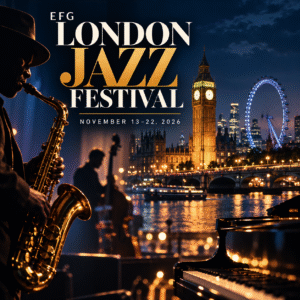

The EFG London Jazz Festival returns to the British capital from November 13–22, 2026, bringing 10 days of concerts, collaborations, premieres and special events to venues throughout London.
Produced by Serious, the annual festival has grown into one of the world’s most expansive celebrations of jazz, with performances taking place everywhere from major concert halls to intimate clubs. This year’s program once again reaches well beyond any single definition of the music, bringing together established jazz masters, contemporary innovators, international artists and musicians working at the intersections of jazz, soul, electronic music and global traditions.
Celebrating John Coltrane at 100
One of the defining themes of the 2026 festival is the centennial of John Coltrane, who was born in 1926 and whose influence continues to shape generations of improvisers.
On the festival’s opening night, November 13, the Barbican will host Coltrane 100: Both Directions at Once, bringing together an extraordinary quintet featuring saxophonists Joe Lovano and Melissa Aldana, pianist Nduduzo Makhathini, bassist Linda May Han Oh and drummer Jeff “Tain” Watts.
Rather than simply recreating Coltrane’s recordings, the musicians will use his compositions and musical philosophy as a foundation for new improvisation and exploration. Lovano has described the project as an effort to create in Coltrane’s spirit rather than reproduce the past. The performance has already sold out.
The Coltrane centennial extends beyond the concert stage as well, with the festival presenting film programming connected to his legacy, including a screening of Spike Lee’s Mo’ Better Blues as part of the Barbican’s Jazz on Screen series.
Miles Davis’ Legacy Also Takes Center Stage
Another towering figure born in 1926, Miles Davis, will also be represented throughout the festival.
British composer, producer and multi-instrumentalist Emma-Jean Thackray presents Dear Miles – A Love Letter on November 13 at EartH Theatre, while the Barbican hosts a screening centered on Davis’ later-period work the following day.
Together, the Coltrane and Davis programming gives this year’s festival an especially strong historical dimension while placing those legacies alongside artists who continue to expand the vocabulary of contemporary jazz.
A Wide-Ranging International Lineup
The festival’s opening weekend alone illustrates the extraordinary breadth of the 2026 program.
The traditional Opening Gala: Jazz Voice takes place November 13 at Royal Festival Hall, while the same evening also features Fergus McCreadie, Sarathy Korwar, Morcheeba, Emma-Jean Thackray and the Coltrane centennial performance.
On November 14, Indian-born vocalist Asha Puthli brings The Cosmic Voyager to the Barbican, while Goldie presents his ambitious Dare to Dream project with live band, orchestra and special guests at Royal Festival Hall. Caravan Palaceand a Duke Ellington tribute featuring Jeru the Damaja are also part of the evening’s programming.
The following night brings another particularly strong slate.
Tunisian oud master Anouar Brahem performs After the Last Sky at the Barbican, trumpeter Ambrose Akinmusire leads his quartet at Kings Place, and pianist Alfredo Rodriguez reunites with percussionist Pedrito Martinez at KOKO.
Elsewhere that evening, vocalist Lizz Wright appears at Cadogan Hall, Portuguese star Mariza performs at Royal Festival Hall, and guitarist and producer Dave Okumu leads a project exploring music associated with figures including Nina Simone and Sly Stone.
Melody Gardot, GoGo Penguin and a Week of Major Performances
The festival continues on November 16 with Melody Gardot performing at Royal Albert Hall, while British trio GoGo Penguin begins a two-night run at KOKO.
Other notable concerts during the week include pianist Roberto Fonseca with cellist Vincent Segal, saxophonist Andy Sheppard with Norma Winstone and Kit Downes, Malian singer and guitarist Fatoumata Diawara, and saxophonist and composer Soweto Kinch.
Norwegian ensemble Jaga Jazzist appears on November 19, while guitarist Isaiah Sharkey performs later that evening at the Jazz Cafe.
The following night includes performances from the Kronos Quartet, trumpeter Nils Petter Molvær, pianist Elliot Galvin, trumpeter Laura Jurd and others.
Robert Glasper Takes Over Blue Note London
One particularly notable component of this year’s festival is the extended appearance of Robert Glasper at Blue Note London.
Glasper is scheduled to perform throughout the festival, from November 13 through November 22, as part of the festival’s “Celebrating the Jazz Clubs” programming.
His residency reflects another defining element of the London Jazz Festival: although some of its highest-profile concerts take place in major halls, the event remains deeply connected to the club culture that has long sustained jazz in the city.
Late-night performances at Ronnie Scott’s and concerts at clubs throughout London run alongside headline appearances at the Barbican, Southbank Centre and Royal Albert Hall, effectively turning the city itself into the festival venue.
A Festival Built Around Jazz Without Borders
What makes the EFG London Jazz Festival particularly distinctive is the scope of what it considers part of the contemporary jazz conversation.
A single edition can move from Joe Lovano and Melissa Aldana to Fatoumata Diawara, Anouar Brahem, Goldie, Mariza, Kronos Quartet and GoGo Penguin without treating those stylistic shifts as contradictions.
Instead, the program reflects a musical culture in which jazz continues to interact with hip-hop, electronic music, African and Middle Eastern traditions, soul, classical composition and experimental music.
That philosophy has helped establish the London festival as more than a collection of headline concerts. Across its 10 days, established artists appear alongside rising musicians, new commissions are presented beside tributes to historic figures, and the city’s clubs operate alongside some of its largest performing arts institutions.
Looking Back While Moving Forward
The centennials of John Coltrane and Miles Davis inevitably give the 2026 festival a powerful sense of history.
But perhaps the most fitting tribute to those musicians is that the festival does not appear interested in treating jazz history as something frozen in time.
Artists including Melissa Aldana, Nduduzo Makhathini, Ambrose Akinmusire, Emma-Jean Thackray and many others are approaching the tradition from entirely different directions, demonstrating how the ideas introduced by previous generations continue to evolve.
From the Barbican and Royal Festival Hall to Ronnie Scott’s and clubs across London, the 2026 EFG London Jazz Festival once again presents jazz not simply as a genre, but as an evolving international musical language.
The EFG London Jazz Festival takes place November 13–22, 2026. The complete schedule and ticket information are available through the festival’s official website.