
Text and photos by Jonathan Widran
L.A.’s Vibrato Grill Jazz was the setting for an all-star tribute to the enduring artistry and multi-genre legacy of George Benson. Balancing musical excellence with a powerful sense of purpose, the intimate November 1 benefit honored the guitarist and singer’s remarkable career while spotlighting the important mission of the event’s sponsor, Jazz Foundation of America (JFA), which provides essential assistance to musicians facing financial hardship, medical challenges and other emergencies.
JFA Executive Director Joe Petrucelli and president Dr. Daveed Frazier opened the festivities by emphasizing the organization’s commitment to helping musicians in need. A video montage featuring supporters and performers including Herbie Hancock, Chaka Khan, Patti Smith, Bettye LaVette, Keith Richards, Sonny Rollins and the late Quincy Jones illustrated the breadth of the community behind its mission. Frazier spoke passionately about music’s capacity to change the world, reminding the audience that jazz is foundational to so much of the music we hear today.
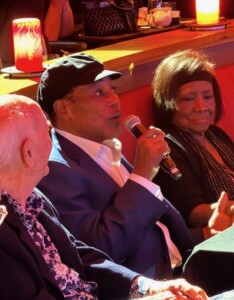
The venue’s co-owner and manager, Eden Alpert — daughter of Herb Alpert — received the Quincy Jones Love & Peace Humanitarian Award, presented by Martina Jones. Alpert observed that musicians spend their lives inspiring others and providing the soundtrack to our most meaningful experiences. The community, she said, has a responsibility to return that generosity by helping artists maintain a roof over their heads and receive necessary medical care. A spirited auction supporting JFA’s Musicians’ Emergency Fund followed, featuring music memorabilia, a Benson-signed Ibanez guitar, a Bahamas getaway and an original painting by bassist Hussain Jiffry.
Carmen Lundy launched the musical program with three songs showcasing her sophistication, emotional openness and improvisational daring. Her first selection “This is Love” — composed by Benson with lyrics by Lundy and Julie Raynor — unfolded over a relaxed mid-tempo groove, with swirling keyboard textures framing her sensual, impassioned delivery. Moving effortlessly between warm lower-register phrases and soaring high notes, Lundy gradually opened into wordless passages and fluid scatting that made her voice feel like another instrument in the ensemble.
“Love and Freedom,” from the singer’s new album Notes From the Wine Cellar, brought a more seductive atmosphere, its graceful rhythms colored by understated piano harmony and a subtle bossa nova flavor. Lundy’s intimate opening vocalizations rose into fluttering upper-register phrases as the lyric explored love, loss and the enduring beauty of a rose even after its petals fall. Her subsequent interpretation of “Moody’s Mood for Love” was her most uninhibited performance. Against a restrained, blues-inflected arrangement, Lundy explored the melody through colorful modulations, dramatic shifts in register and extended scat passages. At times, her voice seemed to improvise with the freedom of a saxophone solo, particularly during the thrilling high notes.
A supergroup of veterans dubbed “The Titans of Jazz” — pianist Patrice Rushen, saxophonist Azar Lawrence, bassist Henry “Skipper” Franklin and drummer Roy McCurdy — followed with a spirited two-song set, opening with a muscular spin on Nat Adderley’s “Work Song.” Its familiar motif, emphatic drum accents and funky pulse quickly developed into a brisk, swinging quartet workout. Lawrence’s soulful tenor soared through freewheeling improvisations, while Rushen delivered an expansive piano solo, McCurdy unleashed a powerhouse drum solo and Franklin added a plucky bass spotlight. Their second selection, “Softly As in a Morning Sunrise,” offered a more spacious setting for Lawrence’s lyrical soprano and Rushen’s adventurous keyboard work, reaffirming the quartet’s remarkable chemistry.
A retrospective video introduced the presentation of the Tommy LiPuma Award for Recording Excellence to Benson, who attended but did not perform. Presented by legendary songwriter Mike Stoller, the honor prompted animated, affectionate reflections from Benson about the people who shaped his career. He credited LiPuma with changing his life after signing him to Warner Bros., recalling how the producer had heard him sing in a San Francisco club and wondered why he wasn’t recording as a singer. That instinct helped lead to the landmark vocal recording of “This Masquerade,” despite initial questions about adding a vocal to an instrumental project. Benson also praised the show’s participating musicians, particularly expressing his excitement at hearing guitarist Isaiah Sharkey.
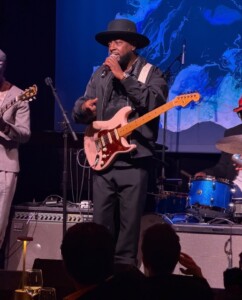
Guitarist Adam Falcon brought a buoyant retro soul-jazz groove to “True Blue,” trading fast-strummed, high-register guitar lines with Ray Fuller over a throbbing bass foundation and elegant keyboards. Sharkey then honored Benson’s signature instrumental “Breezin’,” negotiating its intricate melody with precision while Fuller supplied shimmering harmony lines and a complementary solo. On “This Masquerade,” Sharkey revealed his gifts as a vocalist as well, moving from an extended scat introduction into a graceful, understated interpretation before returning to guitar and improvisation.
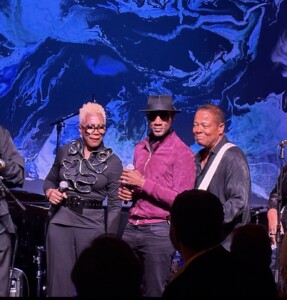
Aloe Blacc turned up the R&B energy with Benson’s Grammy-winning hits “Turn Your Love Around” and “Give Me the Night.” Backed by three vocalists and Sharkey’s nimble guitar work, Blacc delivered charismatic performances that brought the audience to its feet. The latter song became a playful vocal-and-guitar exchange, with Sharkey matching Blacc’s scat passages before the singers joined in an exuberant closing refrain.
Wyclef Jean added a Latin-inflected change of pace with “Lady Havana,” blending spoken rhythmic delivery, playful scat, simmering electric piano and percussion beneath his gritty, island-flavored vocal. The expansive arrangement brought another burst of stylistic color to an already eclectic night.
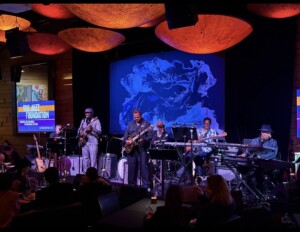
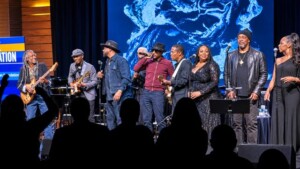
For the finale, the musicians gathered for “On Broadway,” the classic co-written by Stoller and famously covered by Benson. Jean, Blacc, Lundy, Sharkey and Fuller transformed its familiar melody into a joyous communal celebration. Lundy brought smoky intensity to her verse, while the ensemble traded vocal lines, scatting and instrumental improvisations in a high octane call-and-response finish.
The JFA event at Vibrato was both sophisticated and intimate, honoring Benson’s influence without turning the music into a museum piece. Each artist brought a personal perspective to songs that have become part of the broader musical landscape. Just as importantly, the benefit reinforced the Jazz Foundation of America’s belief that honoring musicians means supporting them throughout their lives and careers. The music paid tribute to an extraordinary legacy; the generosity behind the event underscored the community that keeps it alive.