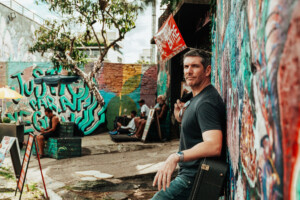

Photo by: Caterina Di Perri / ECM Records
Ralph Towner, a guitarist and composer whose music occupied a world entirely its own, died at 85. Over a career spanning more than five decades, he forged a language that drew from jazz, classical tradition, and global music without ever belonging fully to any of them. His work did not seek synthesis so much as quiet coexistence—multiple histories speaking at once through a singular voice.
Raised in Chehalis, Washington, in a family where music was part of daily life, Towner began playing at an early age and showed unusual fluency across instruments. Piano, trumpet, and French horn came first. The classical guitar entered his life later, in his early twenties, but with life-altering intensity. Study in Vienna with Karl Scheit and deep immersion in Renaissance lute music gave him not only technique, but a lifelong sensitivity to counterpoint, resonance, and form.
Yet Towner’s music was never academic. Brazilian rhythms, the elastic interplay of the Bill Evans Trio, and the possibilities of small-group conversation reshaped his thinking. What emerged was neither fusion nor pastiche, but an approach in which influences were absorbed, blurred, and ultimately rendered untraceable. The result was an idiom that felt both intimate and abstract—instantly recognizable, yet resistant to definition.
His wider introduction came through Weather Report’s I Sing the Body Electric (1972), where his 12-string guitar framed Wayne Shorter’s “The Moors” with a harmonic openness that seemed to suspend gravity. Around the same time, Towner began his long association with ECM Records, entering into a rare partnership with producer Manfred Eicher that valued space, restraint, and long-form musical thought. Albums such as Diary, Solstice, Matchbook (with Gary Burton), Sargasso Sea (with John Abercrombie), and Batik established him as one of the label’s defining artists.
Parallel to his solo and collaborative recordings, Towner co-founded Oregon, an ensemble that expanded the vocabulary of modern chamber jazz through global instrumentation and collective improvisation. Elsewhere, his appearances on recordings by Keith Jarrett, Jan Garbarek, Egberto Gismonti, and Kenny Wheeler revealed a musician whose contribution was rarely decorative; instead, he reshaped the emotional and spatial center of the music from within.
In later decades, living primarily in Italy, Towner gravitated again toward unaccompanied performance. His solo recordings from this period are inward-looking and patient, shaped by memory rather than momentum. They do not argue or announce; they reflect. He often spoke of music as a narrative art without fixed meaning, one that could change direction in real time. That philosophy was audible in every performance.
To listen to Ralph Towner was to enter a carefully balanced world—one where silence mattered as much as sound, and where complexity was offered without insistence. His legacy is not only a catalog of recordings, but a way of listening: attentive, unhurried, and open to discovery.