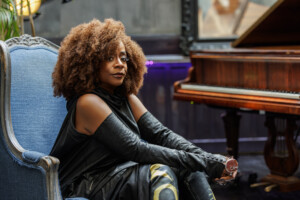

The singular singer, songwriter and 2022 NEA Jazz Master transformed the sound of contemporary jazz by drawing blues, folk, country, soul and popular music into her unmistakable musical world.
Cassandra Wilson, the Grammy Award-winning vocalist whose dark, resonant contralto and fearless approach to repertoire made her one of the most distinctive voices in modern jazz, has died at the age of 70.
Wilson died at her home in her native Jackson, Mississippi, surrounded by family, close friends and her longtime manager, Robert Torre. No cause of death has been announced. News of her passing was confirmed on September 2 by Torre and by officials in Jackson.
Over a career spanning more than four decades, Wilson did considerably more than establish herself as a great jazz singer. She expanded the very idea of what a jazz vocalist could sing — and how a familiar song could be transformed.
With a voice that seemed to emerge from somewhere deep within the earth, Wilson moved comfortably among jazz standards, Delta blues, folk songs, country music, rock and R&B. In her hands, songs associated with artists as disparate as Robert Johnson, Bob Dylan, Neil Young and others could become intensely personal meditations, often stripped of their familiar rhythmic and harmonic surroundings and rebuilt around her phrasing.
That willingness to cross musical boundaries became one of the defining characteristics of her career. The National Endowment for the Arts later credited Wilson with creating a body of work that “expanded the definition of jazz,” honoring her as an NEA Jazz Master in 2022.
Born Cassandra Fowlkes on December 4, 1955, in Jackson, Wilson grew up immersed in music. Her father, Herman B. Fowlkes, was a guitarist and bassist, while her mother, Mary Fowlkes, was a teacher with a love of Motown. Wilson began studying piano at six, later took up guitar and clarinet, and started writing songs as a teenager. She attended Millsaps College before completing a degree in mass communications at Jackson State University.
After spending time in New Orleans, Wilson moved to New York City in the early 1980s and became associated with saxophonist Steve Coleman and the experimental M-Base Collective. The experience placed her in the middle of one of jazz’s most adventurous creative movements, but Wilson would eventually move toward a more acoustic and increasingly personal sound.
That evolution came into brilliant focus with Blue Light ‘Til Dawn, released by Blue Note Records in 1993. The album became a landmark in contemporary vocal jazz, bringing together jazz improvisation, acoustic textures, Delta blues and unconventional song choices in a way that felt both ancient and entirely new. Rather than treating the Great American Songbook as the only foundation for jazz singing, Wilson demonstrated that the broader landscape of American music could serve the same purpose.
Three years later came New Moon Daughter, which further refined that approach and earned Wilson the Grammy Award for Best Jazz Vocal Album. Her interpretation-driven aesthetic made a compelling argument that songs could belong to the interpreter just as deeply as to the songwriter. Wilson could slow a composition down, alter its atmosphere and shift its emotional center until listeners heard it almost as if for the first time.
Her fascination with Miles Davis produced another defining project, Traveling Miles, while albums including Belly of the Sun, Glamoured, Thunderbird, Silver Pony and Another Country continued to explore the crossroads between jazz and other American musical traditions.
Wilson earned four Grammy nominations during her career and won twice: for New Moon Daughter and, more than a decade later, for Loverly, which received the Grammy for Best Jazz Vocal Album in 2009.
She was also an important presence beyond her own recordings. Wilson worked with artists including Terence Blanchard, Bill Frisell, Charlie Haden, Angelique Kidjo, Luther Vandross and Wynton Marsalis, and appeared on Marsalis’ monumental Blood on the Fields, the first jazz composition to receive the Pulitzer Prize for Music.
In 2015, Wilson turned her attention to one of jazz singing’s most enduring figures, Billie Holiday. Her album Coming Forth by Day, released during the centennial of Holiday’s birth, approached Holiday’s repertoire not as imitation but as reinterpretation — filtering those songs through Wilson’s own vocabulary of space, texture, blues and memory. She also marked Holiday’s centennial with a special concert at Harlem’s Apollo Theater.
The accolades accumulated throughout Wilson’s career. Along with her two Grammys, she received the Miles Davis Prize at the Montreal International Jazz Festival, was honored with a marker on the Mississippi Blues Trail and was repeatedly recognized by DownBeat. Time famously called her “America’s Best Singer” in 2001. Her selection as a 2022 NEA Jazz Master, one of America’s highest honors in jazz, served as recognition of a life’s work that had fundamentally broadened the possibilities of the music.
Yet Wilson’s importance cannot be measured simply by awards or record sales.
She belonged to a relatively small group of artists whose sound could be recognized within seconds. The richness of her lower register, her extraordinary patience with a phrase and her willingness to leave space around a lyric gave her performances a sense of gravity. She rarely seemed interested in demonstrating what her voice could do. Instead, every musical decision served the atmosphere and story of the song.
Her Mississippi roots remained at the center of that sound. Jazz, blues, gospel, folk and Southern musical traditions were not separate stylistic ingredients in Wilson’s music; they were part of a continuum. That perspective enabled her to create music that felt simultaneously contemporary and deeply connected to history.
Following news of her death, pianist and singer Jon Batiste remembered the enormous impact of her approach, particularly the way she brought folkloric, R&B, diasporic, experimental and popular music together. Jackson Mayor John Horhn similarly described Wilson as an “extraordinary native daughter” whose music carried the sound and history of Mississippi around the world.
For the generation of jazz singers who followed her, Wilson offered something perhaps even more valuable than a particular vocal style: permission.
Permission to look beyond the standard repertoire. Permission to interpret rock, blues, country or folk without surrendering a jazz identity. Permission to slow a song down, pull it apart and rebuild it according to one’s own musical instincts.
And in doing so, Cassandra Wilson created a sound that ultimately belonged to no category but her own.
At the close of a 2022 conversation marking her selection as an NEA Jazz Master, Wilson reflected on receiving recognition for her life’s work.
She spoke of the extraordinary musicians, people and audiences she had encountered across a lifetime in music before concluding simply that “it’s been a wonderful life.”
For listeners around the world — and for jazz itself — it was a remarkable one.
JAZZIZ Editor Bob Weinberg’s Requisite for Cassandra Wilson: https://www.jazzizdiscovery.com/requisite-cassandra-wilson/